Thursday, December 1, 2011

SciPy.in 2011 coming soon to IIT Bombay


If you aren't aware of it yet, SciPy.in 2011 is just round the corner.
This year it is going to be held at IIT Bombay's new Victor Menezes
Convention Center (VMCC).  We have conference talks on 4th and 5th and
tutorials on 6th and 7th.  We have invited several key people from
the "scientific computing with Python" community.  We have an awesome set
of talks and tutorials.  Eric Jones from Enthought is our keynote
speaker.

In 2009 and 2010 we did workshops on basic scientific computing with
Python.  This year our tutorial track features several advanced topics
including, image processing, machine learning, symbolic computing,
mapping and geoprocessing, Traits/TraitsUI, Mayavi, Sage and Cython.

If you wish to attend the conference,  feel free to drop in and attend,
free of cost -- but you'll miss out on the awesome food, t-shirt and
other goodies if you do not register.  It would be best if you did
register though.

The main organizers of SciPy.in 2011 are FOSSEE.  Enthought (India) is
also helping organize the conference.  MHRD and Enthought are our
financial sponsors and we are grateful to them for their continued
support.

Given the nature of the talks, the tutorials, the location, you are
going to miss out if you choose to not attend.  Register before 2nd to
avail of reduced rates.  Spot registration is certainly available but is more
expensive.

Sunday, November 27, 2011

Enthought ... now in India

Enthought, as most of you (following my blog anyway) know,
is a leading scientific computing solutions provider and an extra-ordinary
champion of scientific computing with Python. Enthought is headquartered
at Austin, Texas and has offices in New York, Cambridge (UK) and Brussels.
Enthought has started a new development office in Mumbai, India. Starting July 2010,
I am taking two years of long leave (lien) from IITB to serve as the
Managing Director of Enthought India. We have a nice office located at the Supreme
business park in Hiranandani, Powai.


We right now have three people (including yours truly) and are looking
for more people. We aim to build a strong development team. We are
currently working on an exciting new product that we will release over
the course of next year. Stay tuned!

If you are a strong Python developer with a penchant for challenging
problems and building scientific computing applications, do send us your
resume.

I can be reached on my usual email addresses and my Enthought email is
prabhu at enthought dot com. Possibly the best place to send in resumes is:
india-jobs@enthought.com

FOSSEE updates

The FOSSEE project started in mid 2009 and has been doing fairly well.
We've conducted several Python and Scilab workshops all over India. We
organized two SciPy.in conferences (2009 and 2010) and hosted Sage days
25. This year we are organizing SciPy.in 2011 at IIT Bombay.

We've generated plenty of introductory material on elementary Python for
scientific computing, version control and using GNU/Linux tools. Using
this material we are conducting a "Software development techniques for
engineers and scientists" course at IITB. There are numerous other
initiatives including a textbook conversion project that we are working
on.

Recently, and rather significantly, we've have embarked on an ambitious
effort to train about 650 teachers all over India over five weekends
this month on "Software development techniques for engineers and
scientists". This is part of Prof. Phatak's IIT e-Outreach program
funded generously by the MHRD, India. More details are available here.

The basic idea is that we conduct workshops at IIT Bombay and the
lectures are streamed online. Students are able to interact with the
faculty via the internet. We are very excited about this since this
allows us to reach out to a large number of people in one shot. It is
also a tad scary since the numbers are so large. So far it has worked fairly well.

I did write a simple Django based application to take online exams and automatically
grade the submitted solutions and will probably talk about that in more detail
at a future point.

... and they lived happily ever after


It has been two years since I blogged about anything significant. A lot
has happened and I thought I might as well give everyone a news update.

In November 2009, Kadambari Devarajan (KD) and I were married. I'm not
getting into the details here but in short, she stole my heart, I
proposed, we were married in November and we lived happily ever after.
:)

The marriage ceremony was smooth and memorable thanks in very little
part to the two of us. My parents organized a wonderful, short and
thoughtful marriage ceremony and KD's parents a wonderful reception. We
cannot thank our parents enough! My cousins thoughtfully organized and
hosted a mehendi party which was very memorable. The support of our
siblings at this time was touching. Close friends and relatives
travelled from far and wide to attend the marriage and made it very
special for us. Many friends and relatives offered us their advice,
support and help. Many of you attended the wedding at short notice and
showered us with gifts and good wishes. Our heartfelt thanks to one and
all!


Ever since, KD and I have been extremely happy together. Life has
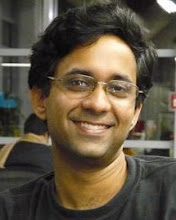
changed in many ways. We've travelled the world (the picture above was
at Yosemite, courtesy Jarrod Millman), done many things together and
are having a wonderful time. Thanks again to all of you who got
us together. :)


Friday, October 2, 2009

SciPy India conference in Dec. 2009

I'm excited to announce that the first "Scientific Computing with Python" conference in India (http://scipy.in) will be held from December 12th to 17th, 2009 at the Technopark in Trivandrum, Kerala, India.

The theme of the conference will be "Scientific Python in Action" with respect to application and teaching. We are pleased to have Travis Oliphant, the creator and lead developer of numpy as the keynote speaker.

Here is a rough schedule of the conference:

Sat. Dec. 12 (conference)
Sun. Dec. 13 (conference)
Mon. Dec. 14 (tutorials)
Tues. Dec. 15 (tutorials)
Wed. Dec. 16 (sprint)
Thu. Dec. 17 (sprint)

The tutorial sessions will have two tracks, one specifically for teachers and one for the general public.

There are no registration fees.

Please register at:

http://scipy.in

The call for papers will be announced soon.

This conference is organized by the FOSSEE project funded by the Ministry of Human Resources and Development's National Mission on Education (NME) through Information and Communication Technology (ICT) jointly with SPACE-Kerala.

Monday, March 9, 2009

Sage notebook, Mayavi2 and 3D interaction on the web

Thanks to a cool open source x3d viewer along with its browser plugin -- freewrl, I can now use mayavi2 in a sage notebook and also get 3d interactivity! To see this in action see here. You should see something that looks like this:

The view on the bottom supports full 3d interactivity, which is really quite cool. This works seamlessly with the debian package on the freewrl site. I just installed the packge on my Ubuntu 8.04 machine and it works really nicely. The only trouble is that for more complex visualizations, the x3d file exported can be quite large but this can be partially alleviated by perhaps using mod_deflate and similar options on the server.

Now the x3d embedding above is a hack currently since I manually embedded the necessary HTML tag into the sage worksheet but as can be gleaned from this thread, this should be trivial to add to Sage proper. This opens up an exciting new possibility for mayavi2 on the web.

Saturday, March 7, 2009

Mayavi2 in a Sage notebook on the web!

I've been pretty hopeless at blogging (or even responding to comments on my blog) but this was too good to not blog about. Ondrej Certik has setup a Sage notebook on the web with support for Mayavi2. This lets you generate pictures using mayavi2 offline, from anywhere on the web and see them as static images. No interactivity yet but that is technically possible and may happen sometime.

Ondrej blogged about this very briefly and mentioned his struggle on getting mayavi2 working in sage. Here is a link to his first attempt demonstrating a mayavi plot on the hpfem notebook:

http://nb.hpfem.org/home/pub/12/


I made a little worksheet with a few of the standard mayavi test cases here:

http://nb.hpfem.org/home/pub/16/


If your browser shows you a text rendering of the above, download the Force HTML bookmarklet from here and click on that, you should see the page nicely.

Quite a bit of work went into this before we got this far. I spent several hours figuring out how to get VTK built reliably so it can work for this. There was a minor bug in mlab that was fixed by Gael and me. Ondrej then figured out (after much pain) how to get mayavi2 and sage working nicely together. Jaap Spies' very cool mayavi2 packages for sage were also a big help I believe. Ondrej then ran into trouble with memory issues with the virtual machine he hosts this on. Once that was resolved this became possible.

Needless to say, this opens up some very interesting possibilities and is very cool.